
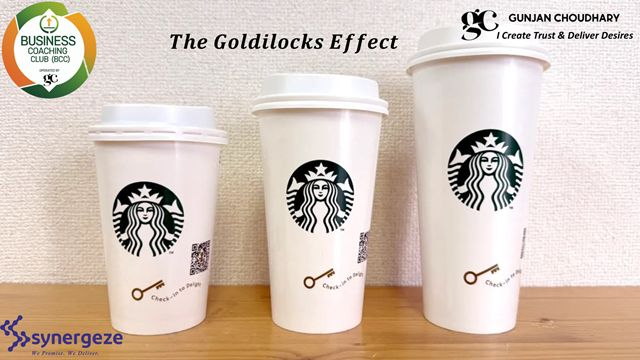
The Goldilocks Effect
The Goldilocks Effect is a powerful marketing and pricing strategy based on the idea that when customers are presented with three options—one low, one high, and one in the middle—they are naturally drawn to the middle option, perceiving it as “just right”. This principle, inspired by the Goldilocks fairy tale, helps brands influence purchasing decisions and maximize sales.
How Big Brands Use the Goldilocks Effect
Starbucks:
When you walk into Starbucks, you’ll notice three main cup sizes: Tall, Grande, and Venti. Most customers choose the Grande—not too small, not too large, but just right. Starbucks intentionally positions the middle size as the most appealing, driving the majority of sales to that option
Apple:
Apple’s iPhone lineup is a textbook example. They offer a basic model, a premium Pro Max, and a mid-tier Pro. Most customers skip the cheapest and the most expensive, opting for the mid-range model, which feels like the best balance of features and price. This strategy not only increases sales but also raises the average selling price.
Why Does the Goldilocks Effect Work?
~ Avoiding Extremes: Customers tend to avoid the cheapest option (which may seem low quality) and the most expensive (which may feel excessive), gravitating toward the middle as a safe, reasonable choice.
~ Empowered Choice: Presenting multiple options makes customers feel in control, increasing the likelihood they’ll make a purchase rather than walk away.
~ Perceived Value: The middle option is often designed to look like the best value, subtly nudging customers toward it.
How Small Businesses Can Use the Goldilocks Effect
You don’t need to be a giant like Starbucks or Apple to benefit. Here’s how small businesses—whether selling products or services—can implement this strategy:
~ Tiered Offerings: Create three versions of your product or service: basic, standard (middle), and premium. For example, a consulting firm could offer starter, growth, and enterprise packages.
~ Highlight the Middle Option: Make the middle tier the most attractive by bundling popular features or services and visually emphasizing it in your marketing materials.
~ Strategic Pricing: Set the lowest tier to cover basic needs at a competitive price, the middle tier as the “best value,” and the premium tier with extra features at a higher price point.
~ Guide the Customer: Train your team to recommend the middle option as the most popular or best fit for most clients, reinforcing its appeal.
Final Thought
This is a simple yet effective way to guide customers toward the option you want them to choose, increasing both sales and satisfaction. By thoughtfully structuring your offerings, even small businesses can leverage this psychological principle to compete with the best in the market.